Investing $1,600 Per Month at 9%
For years, I heard people say:
“$100k is 25% of the way to $1 million.”
Mathematically, that’s wrong.
$100,000 is only 10% of $1M.
But after running my own numbers, I realized something more interesting:
For my situation, around $200,000 is the true game-changer.
Here’s why.
My Assumptions
- Monthly investment: $1,600
- Annual contribution: $19,200
- Expected long-term return: 9% annually
- Starting from: $0
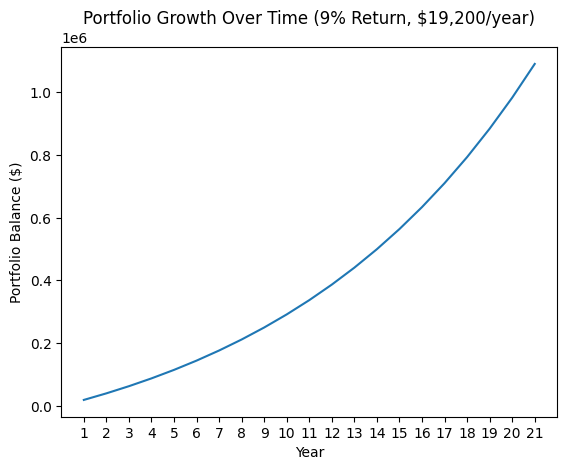
Portfolio Growth Over Time
The first chart above shows what happens over 21 years.
You reach:
- ~$115k in Year 5
- ~$250k in Year 9
- ~$500k in Year 14
- ~$1M in Year 21
At first, growth feels slow.
But look at the curve — it bends upward more and more aggressively over time. That’s compounding doing its job.
The Real Breakthrough: When Money Matches My Effort
Here’s the key insight.
I contribute:
- $19,200 per year
So I asked:
When does 9% of my portfolio equal $19,200?
That happens at:
So roughly:
🎯 $213,000 is the crossover point
At that level:
- My portfolio generates ~$19,200 per year
- I contribute ~$19,200 per year
- Total annual growth ≈ $38,400
My investments are now working as hard as I am.
That happens around Year 8–9.
The Second Chart Explains Everything
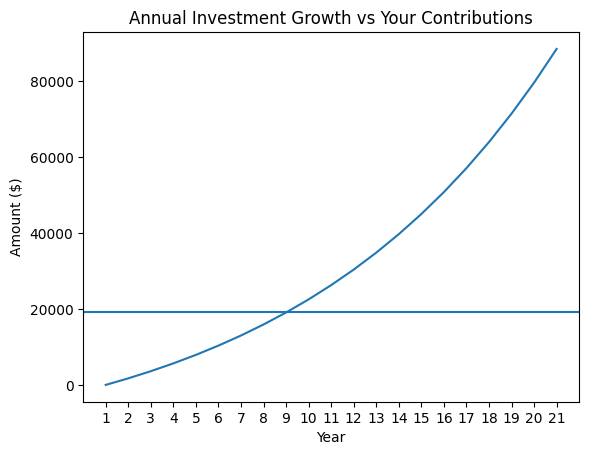
The second chart shows:
- The rising blue curve = annual investment growth
- The horizontal line = my $19,200 yearly contributions
Notice when the curve crosses the line — that’s the moment compounding equals my effort.
After that?
Returns grow faster than my savings.
What Happens After $200k?
This is where things get exciting:
At $500k:
- 9% = $45,000 per year
- More than double my contribution
At $1M:
- 9% = $90,000 per year
- Almost 5× what I invest annually
Eventually, work becomes optional long before $1M if expenses are controlled.
Why $200k Matters More Than $100k (For Me)
$100k is a great milestone.
But $200k is:
- When compounding becomes equal to my effort
- When progress accelerates noticeably
- When wealth starts to feel self-propelling
That’s when money becomes a second income stream.
Final Thought
The journey to $1M isn’t linear.
The first few years feel slow.
The middle years feel steady.
The final years feel explosive.
And for my numbers at 9%:
$200k is the psychological and mathematical inflection point.